
Executive Summary
Frontier AI has turned CVE weaponization timelines to hours, making scan-bound detection a growing compliance and breach-risk challenge. Agent Insta powers InstaScan to deliver scanless detection by transforming existing inventory, telemetry, and threat intelligence into validated exposure findings within minutes of disclosure. Operating 24/7, InstaScan enables AI-speed detection with 90%+ coverage across technologies representing 60–70% of enterprise vulnerability volume. Qualys is the first unified risk management platform to natively close the loop from detection to remediation in minutes. InstaScan detects vulnerabilities within an hour of disclosure; scanners and agents provide authoritative confirmation; Agent Val validates which are exploitable; TruRisk Eliminate remediates them; and Agent Val proves the fix. No third-party stitching. No dependency on stale or incomplete data.
The Clock Security Teams Are Actually Running Against
Somewhere between a CVE’s publication and your next scheduled scan, an attacker already has a working exploit. That gap used to be measured in weeks. Today, it’s measured in hours, and for most enterprise security teams, it’s invisible until the scan finally runs.
Every vulnerability management program operates on a silent clock. The countdown begins at CVE disclosure and ends when an attacker develops a working exploit. Historically, this window provided a sufficient buffer to run scheduled scans, analyze the findings, and deploy patches before an exposure became a breach.
That window is now closed. Frontier AI accelerates the weaponization of vulnerabilities, compressing timelines from days to mere hours. The numbers make it concrete: a record 48,177 CVEs were published in 2025, on pace for roughly 59,000 in 2026, while the median time from disclosure to the first working exploit collapsed from 56 days in 2024 to 23 days in 2025, and is now a matter of hours. AI-assisted attackers now weaponize new advisories in as little as 4 to 12 hours, and vulnerability exploitation has surged 34 percent year over year, making it the entry point in one of every five breaches, according to the Verizon DBIR.
Despite this shift, most enterprise detection programs remain anchored to legacy models built for a slower era. The scheduled scan windows, credentialed scan jobs, signature builds, and agent re-evaluation that most programs still depend on typically deliver visibility 24 to 36 hours after disclosure, long after a modern attacker has already weaponized the vulnerability.
When remediation mandates from CERT-IN and CISA compress the patch window to as little as 12-24 hours, and detection and prioritization alone consume ~10 of those hours, it has become necessary to detect vulnerabilities at machine speed to ensure that remediation guidelines are not violated.
This 24-to-36-hour latency between rapid disclosure and scheduled detection has ceased to be a minor operational bottleneck. It is a severe strategic risk. Security teams operating in an AI-accelerated threat landscape must address this gap directly to defend their attack surface.
Why Scan-Driven Detection Cannot Keep Up
Scan-driven detection worked well for nearly two decades, but three structural constraints now stand in the way of AI-speed defense.
- Built-In Latency: Detection is handcuffed to scheduled scans and signature releases. Even top-tier programs operating on a daily cadence hands attackers a 24-hour head start, an unacceptable margin of operational risk.
- Fragmented Coverage: Telemetry is trapped in silos. Data from first-party scanners and third-party platforms rarely converges into a single, defensible source of truth. Analysts burn critical cycles reconciling partial datasets instead of executing responses.
- Operational Friction: Network scans tax infrastructure. Every new agent deployment or action demands IT coordination and maintenance windows, creating bureaucratic bottlenecks that actively throttle time-to-remediation.
These constraints aren’t new, but frontier AI has made them critical. The operational cost of latency has spiked. Scheduled detection jobs are now fundamentally incompatible with threat actors moving at disclosure speed.
Introducing InstaScan
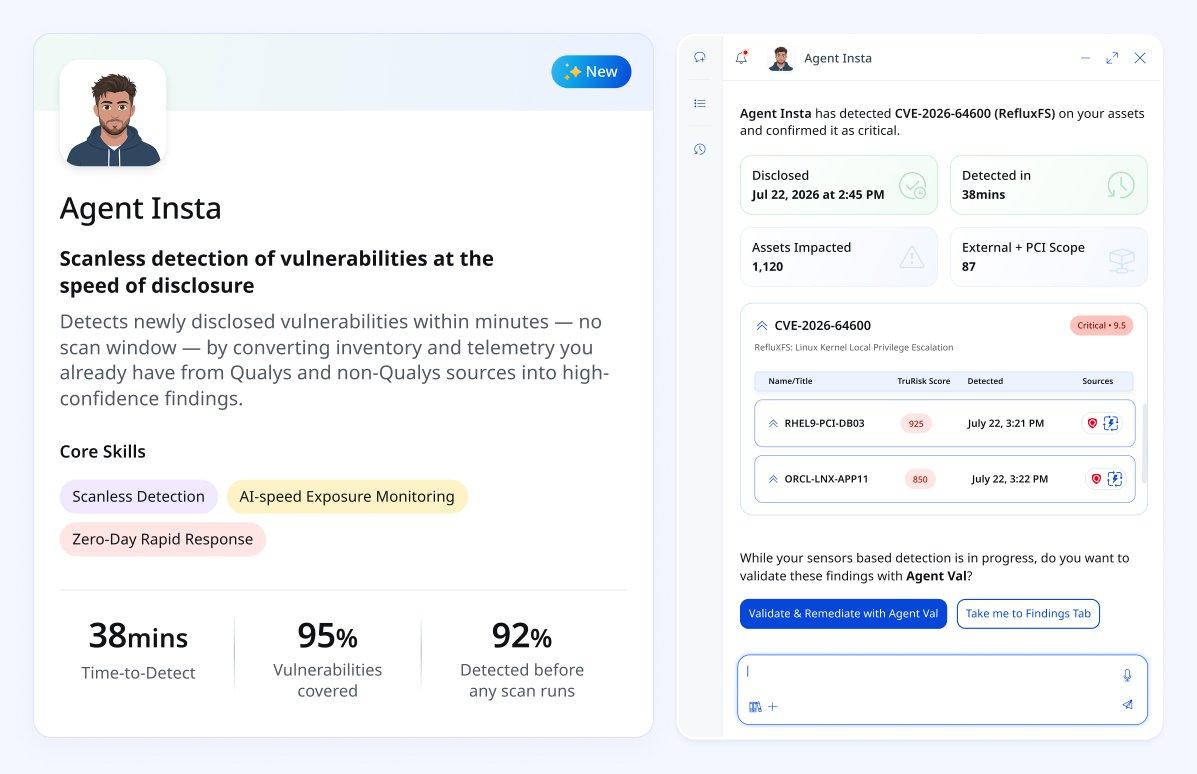
InstaScan, powered by Agent Insta, is the industry’s first scanless detection capability. It continuously correlates every new vendor advisory against the software and asset telemetry, exposure, and threat context that Qualys already holds (collected from Qualys and 3rd-party tools), detecting new vulnerabilities at AI speed with no scan window and no dependence on which scanner an organization runs. The result is scanless scanning detection triggered by the moment the world changes, not by the next calendar event in your scan schedule.
Agent Insta operates silently and continuously within the Qualys knowledge layer, evaluating the normalized software inventory, endpoint telemetry, CVE advisories, and asset context that Qualys already holds, and firing detection events the moment a new advisory is published. Instead of waiting for a scheduled scan to confirm exposure, InstaScan evaluates existing data against new intelligence in real time.
InstaScan flips the traditional detection paradigm. Instead of waiting for a scan cycle to discover what is installed, InstaScan maintains a continuous correlation between your live inventory and the latest vulnerability disclosures. Detection is no longer a scheduled event; it is an immediate, threat-driven response.

See Agent Insta in Action
What InstaScan Delivers
InstaScan doesn’t just narrow the gap between disclosure and detection; it erases it. Across the technologies that make up 60-70% of typical enterprise vulnerability volume, InstaScan delivers over 90% of all exposure detections instantly, without a single scan job ever running. This powerful capability equips defenders with the rapid response times that adversaries already exploit, ensures compliance with the full remediation window mandated by regulators, and turns detection from a mere calendar event into an ongoing, proactive state. Powered by Agent Insta, InstaScan helps organizations:
- Detect at the speed of disclosure: Agent Insta automatically correlates newly published CVE advisories against live asset inventories, rapidly identifying affected assets within minutes of disclosure across both Qualys-managed and third-party environments, eliminating the delays of traditional scan-based approaches.
- Outpace the AI-accelerated surge: As cyber adversaries rapidly weaponize CVEs, minute-level detection is critical for reducing exposure windows. By identifying affected assets before traditional scanning completes, teams can initiate remediation earlier with continuously updated, actionable exposure intelligence.
- Reclaim Time to Remediate: Every hour spent detecting is an hour attackers get to move. AI-normalized, confidence-scored detections give downstream prioritization and remediation workflows a trusted signal to act on.
How Agent Insta Powers InstaScan: From Advisory to Finding
Agent Insta is the Qualys backend intelligence agent that powers InstaScan, operating 24×7 to continuously transform existing inventory, telemetry, and threat intelligence into scanless vulnerability detection. Built into the Qualys vulnerability analysis fabric, it identifies affected assets within minutes of disclosure, rather than waiting for scan cycles, making the platform faster, more accurate, and ready for autonomous security operations.

From newly published advisories to validated findings, InstaScan continuously moves through five stages:
- Build a trusted software inventory: Customer environments describe the same software in many different ways. Scan agents, SBOMs, registry entries, CMDBs, Qualys sensors, and third-party inventories often reference identical software using inconsistent names and formats. InstaScan continuously ingests this data to establish a single inventory foundation.
- Normalize software identity with AI: An AI-powered retrieval model resolves each software record to standard industry identifiers such as CPEs and PURLs, even when naming is inconsistent or incomplete. This enables InstaScan to recognize equivalent software representations across multiple data sources accurately.
- Create a canonical inventory: Every AI-generated match is confidence-scored before duplicate software records are consolidated into a single canonical inventory. This keeps the catalog accurate and prevents a single package from inflating the asset and risk picture into several disconnected entries.
- Continuously monitor new threats: Operating 24×7, Agent Insta continuously ingests CVE disclosures, vendor advisories, and threat intelligence as they are published, rather than waiting for scheduled update cycles. Every advisory is immediately transformed into structured, actionable detection intelligence.
- Correlate and Confirm: As new intelligence arrives, InstaScan correlates normalized threat data against the canonical inventory using existing Qualys agents, scanners, sensors, and imported third-party telemetry. Every potential detection is validated for inventory freshness, match precision, asset relevance, and criticality, and only high-confidence findings are published to TruRisk and downstream workflows.

The business outcome is a continuous, scanless detection layer that identifies affected assets within minutes of disclosure without launching new scan jobs, redeploying agents, or waiting for IT coordination windows. By maximizing the value of existing telemetry, it replaces scan cadence with continuous intelligence, enabling earlier prioritization, faster remediation, and a platform ready for autonomous security operations.
Why InstaScan Breaks the Legacy Scanning Model
InstaScan is a complete structural shift from a batch-dependent, scan-bound process to an intelligence-driven, continuously evaluated model. This pivot to scanless scanning changes the operational baseline in three specific ways:
- Threat-Aligned Cadence: It synchronizes detection with the speed of vulnerability disclosures, eliminating the delay of scheduled jobs.
- Unified Telemetry: It consolidates first- and third-party inventory data into a single, confidence-scored detection stream.
- Automation Readiness: It establishes the clean, normalized signal layer required to execute autonomous remediation safely at enterprise scale.
Scanless scanning is not just a feature enhancement to legacy vulnerability management. It is a new detection model for an AI-speed threat environment. Enterprises already have rich telemetry spread across agents, sensors, cloud platforms, and third-party systems. The challenge is not always collecting more. The challenge is turning what is already known into immediate, defensible exposure visibility the moment a new risk emerges. InstaScan is designed to do exactly that.
How InstaScan Strengthens the Rest of the Platform
InstaScan does not operate in isolation. It is the upstream signal layer that makes the rest of the Qualys platform’s promises defensible in production.
- AI-Speed Detection – InstaScan surfaces exposure within minutes of disclosure using advisory intelligence, version-aware correlation, and existing inventory, closing the window between disclosure and visibility instead of just narrowing it. To keep this trust model airtight, Qualys Cloud Agents, network scanners, container security sensors, and third-party tools continue to run on their normal cadence and independently reaffirm every InstaScan finding.
- Hyper-Prioritization – Prioritization is only as good as the detection feeding it. InstaScan feeds TruRisk with cleaner inventory, broader signal, and faster CVE matches, so prioritization runs against current reality rather than the last scan cycle.
- Autonomous Remediation – Autonomous and semi-autonomous remediation cannot fire safely on noisy or stale findings. InstaScan’s confidence-scored detections give Agent Val and remediation workflows a faster, trusted signal to act on.
InstaScan and Agent Val, in particular, are designed to work in tandem. InstaScan runs in the background, detecting at disclosure speed, while Agent Val operates in the foreground, validating and remediating what it finds, and closing the loop from discovery to resolution within the same window that now mandates demand. Read more about how Agent Val closes the validation gap.
What This Means for Security Teams
For vulnerability management and exposure management teams, this changes the conversation from “when will the next scan confirm exposure?” to “what changed, where are we exposed, and how fast can we act?” That is a meaningful shift for teams trying to reduce dwell time between disclosure, prioritization, and remediation while also containing operational overhead. It is also a more practical answer to the reality of AI-accelerated threats, where speed without confidence is dangerous, and confidence without speed is no longer enough.
With InstaScan, Qualys is putting a stake in the ground around a category that the market is ready to understand: scanless scanning. It captures a deep shift in how modern exposure detection should work. Not tied to the scan window. Not stalled by batch cycles. Not waiting for more friction to create more visibility. Just immediate, intelligence-driven detection at the speed disclosure now demands.
See Agent Insta In Action
InstaScan is available now within the Qualys ETM platform. To show management that you are Frontier AI era-ready and to see how InstaScan can turn the inventory and telemetry you already have into high-confidence exposure visibility within minutes of the next advisory, contact your Qualys Technical Account Manager (TAM) or start a free ETM trial.


Leave A Comment